


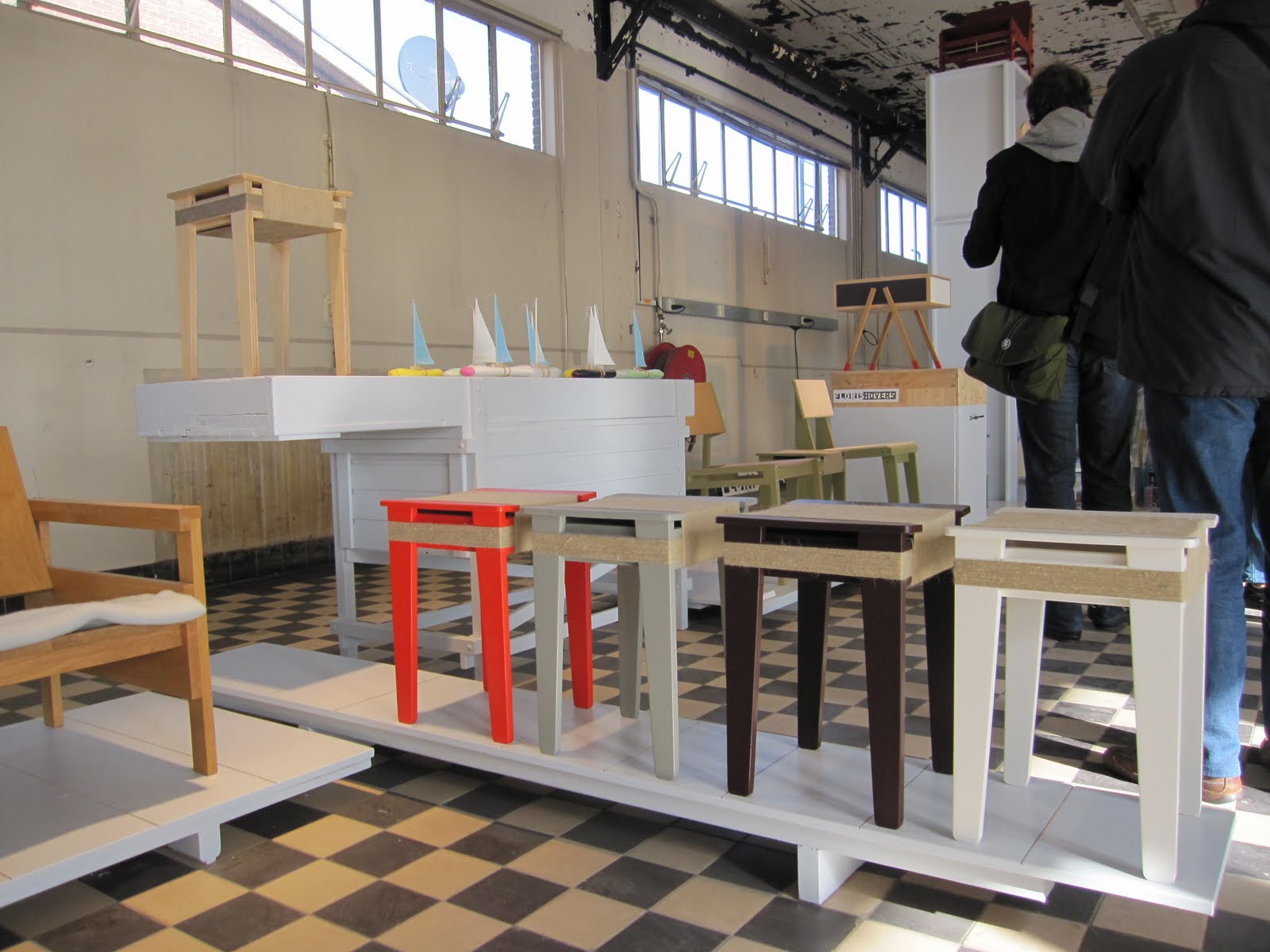
Piet Hein Eek’s new showroom is placed in an industrial setting within a reconstructed and renovated ceramics factory in Eindhoven. His entire collection is on show there. Before that, one was only able to see it piece by piece in the odd gallery.
On the whole, I’d say that Piet Hein Eek is not as recognizable on the international design scene as some other Dutch designers. This, however, is not the case in the Netherlands. Here, he is one of the biggest household names. A Dutchman will take pride in owning a piece or two of Piet Hein Eek.
One is surprised to find, again and again, that Dutch people have often never heard of Droog, while at the same time they are more likely to know who Piet Hein Eek is.
 Piet Hein Eek himself
This may be because his design, more than any other, fits with the Dutch no-nonsense mentality. A chair is a chair, not a monument. And that despite the fact that Eek’s designs are actually quite monumental in their appearance: more often than not they are made of heavy wood or metal. This is exactly how a regular protestant Dutchman will have it: monumental, but not a monument.
Industrial and large rather than cozy and to size, Eek’s designs are best placed within renovated old Dutch warehouses. And they are, too. No matter how spacy and empty the loft or the office is, Eek’s furniture makes it warmer (albeit not any lighter).


And against all that, there is nothing pretentious about Piek Hein Eek’s designs (apart from, maybe, the people owning them). His products are not polished, sleek and shiny: often, they will appear unfinished. They look as if they came straight out of a craftsman’s workshop. These designs are not humorous or playful, either. They are quite straightforward, blunt and honest.
Personally, I'm attached to his scrapwood collection. The scrapboard cupboard, presented as his final exam project at Eindhoven Design Academy, remains to be among his best-selling products. “The scrapwood cupboard from 1990,’ he stated, “was my reaction against the prevalent craving for flawlessness.” He made it from (carefully selected) pieces of discarded wood of different colours and textures. He made many since, and each is one of a kind.

His scrapboard cupboard (featured above) appeared in practically any eco-design or conscientious design list, yet Eek himself never placed it solely or even mainly in that context. The philosophy behind this collection was to make a product that could be made with limited means. “The challenge remains,” he explains his continuing motivation and drive, “to get the maximum out of the circumstances.” If the basic economic principle of today's society is to save the labour, Eek turned that completely around. He uses discarded and cheap materials and adds as much labour as possible to them. "Eventually,' he claims, "people notice all the attention that goes into making the piece."




 Posts


